
Naming on the internet is changing.
But the rules governing it haven’t caught up.
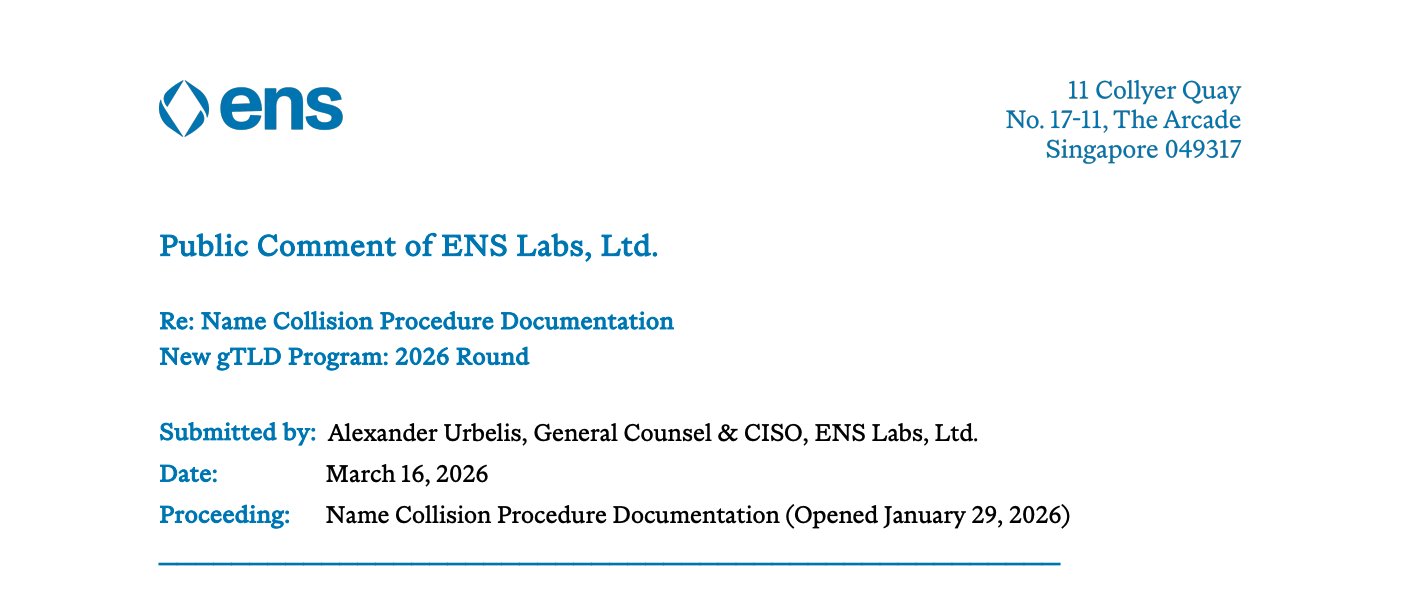
ENS Labs just submitted a public comment to ICANN on “name collisions,” and it highlights a deeper issue with how naming is still being approached.
Here’s why it matters. ↓
For decades, naming was built around a simple assumption. DNS defined what names meant, and ICANN managed the root.
That worked when naming lived in one system.
It does not hold anymore.
Today, names exist across wallets, applications, blockchains, and browsers, and users move between them without thinking about the underlying system.
ENS names already resolve across many of these environments.
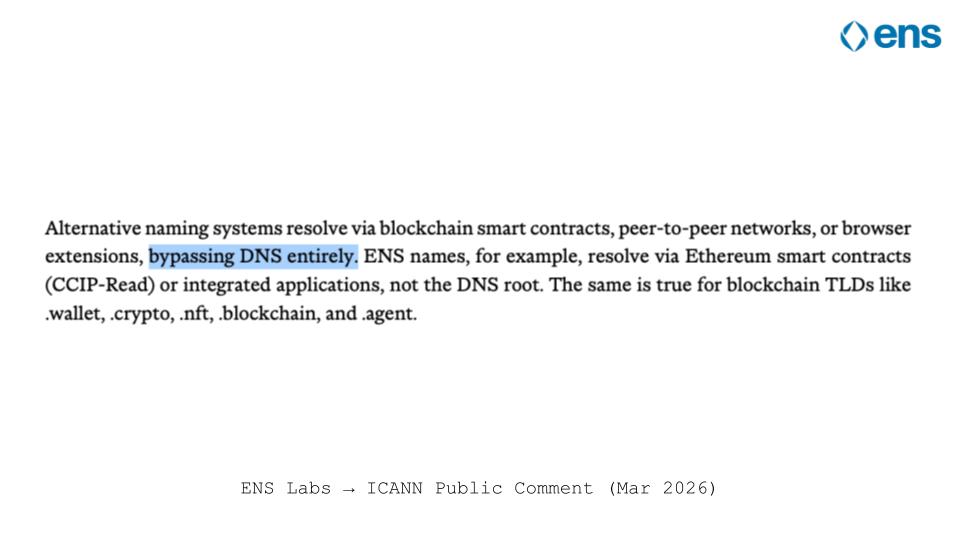
At the same time, ICANN's upcoming gTLD round will introduce new domain extensions. Some of these strings already resolve in wallets, browsers, and crypto applications today.
In a multi-system world, this is where the risk begins.
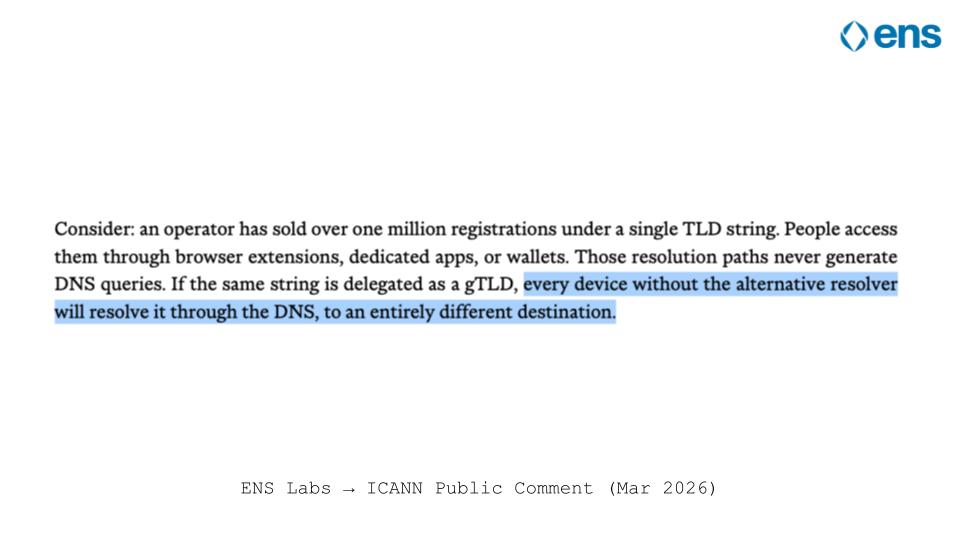
When the same name exists in multiple systems but resolves differently depending on context, you get a name collision.
What used to be a DNS issue is now an internet-wide problem.
This is because in crypto, a name is not just a label. It can point to a wallet, route value, or represent identity.
When resolution breaks, the consequences are not just confusion. They can be financial.
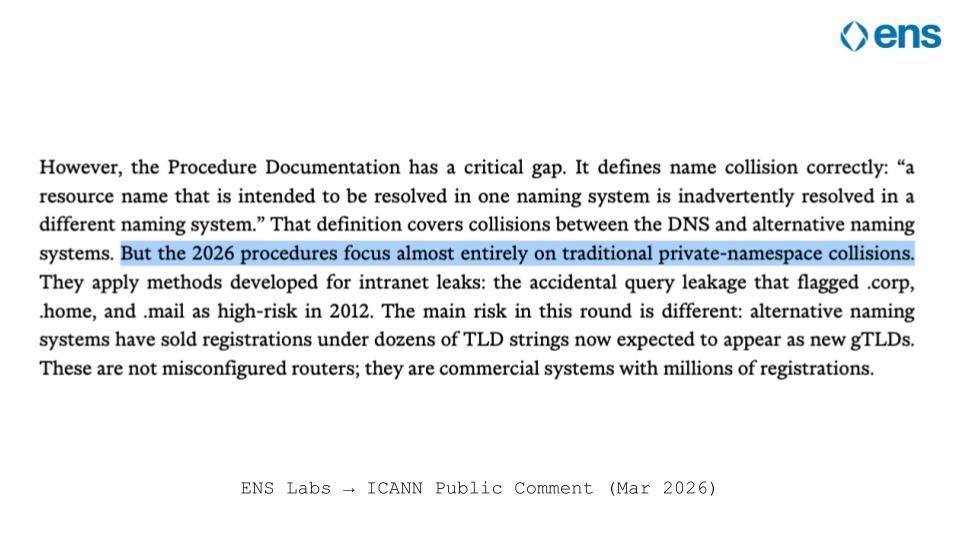
ICANN’s current approach still treats collisions as a DNS-only problem.
But naming has already expanded beyond DNS, and ignoring that does not prevent collisions. It guarantees they are handled incompletely.
Without coordination, this leads to fragmentation, where multiple namespaces emerge and the same name carries different meanings across systems.
At that point, identity stops being reliable.
ENS takes a different approach by treating names as shared infrastructure, designed to resolve consistently across wallets, apps, chains, and the web.
This only works if names are stable, persistent, and built with long-term responsibility in mind.
Identity cannot depend on systems that can disappear or change overnight.
We are applying for .ens in the upcoming gTLD round.
If naming is to serve as global identity, it must be secure, interoperable, and built to last.
Teams exploring Web3 naming in the DNS can reach out.
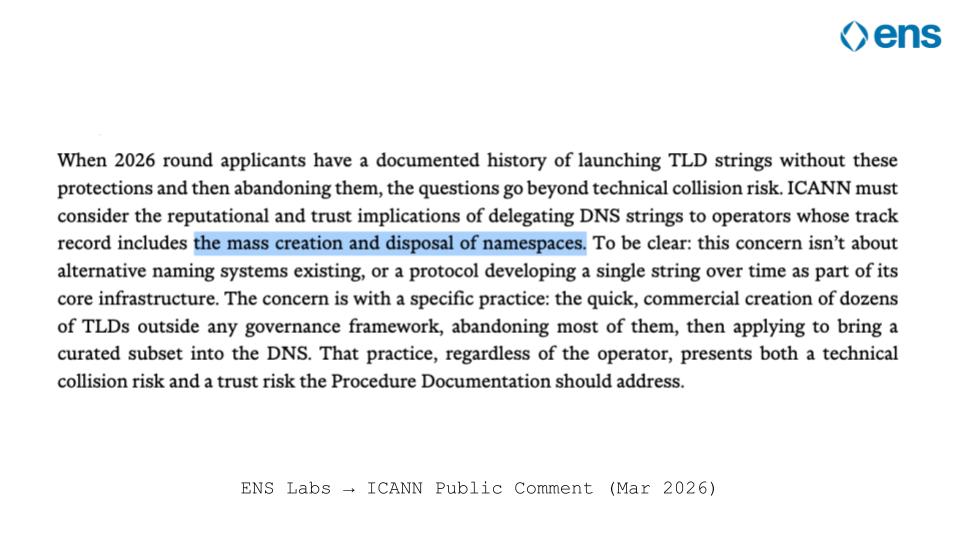
Read our complete statement by @aurbelis ⤵️